
Guardian System
Guardian System
Complete Control Over Who Can Access What
The best security system in the world is useless if it creates a new single point of failure. Key Man Out's Guardian System provides granular control over asset access while ensuring business continuity—without compromising security.
The Three-Tier Role Hierarchy
Custodian: The Owner
Complete Control, Ultimate Responsibility
The custodian is the asset owner—the person who uploaded the secret and maintains full control over it.
Capabilities:
- Create and manage assets
- Define access rules and approval workflows
- Assign and remove guardians at any time
- Approve or deny access requests
- Receive notifications of all asset activity
- Decrypt the asset's secret and files with their personal identity at any time
Use Cases:
- CEO protecting company credentials
- IT manager safeguarding infrastructure keys
- Patriarch securing estate documents
- Lead developer managing API secrets
Key Principle: The custodian can always override any access decision. Final authority rests with ownership.
Gatekeeper: The Overseer
Oversight Without Access
Gatekeepers provide an additional security layer through approval authority—without gaining access to the secrets themselves.
Capabilities:
- Review and approve access requests
- Deny suspicious access attempts
- Receive notifications of access activity
- Cannot decrypt asset content through the Gatekeeper role - even with their personal identity unlocked
- Cannot modify assets or assign guardians
- Can be removed by custodian at any time
Use Cases:
- Board member overseeing CEO's emergency access
- Compliance officer reviewing credential access requests
- Spouse providing oversight on business secrets
- Senior manager approving team access to sensitive systems
- Attorney monitoring access to estate documents
Key Principle: Gatekeepers provide checks and balances without creating insider threats. They can prevent unauthorized access but can't become unauthorized accessors themselves.
Successor: The Contingency Plan
Access When Custodian Cannot Respond
Successors are your business continuity plan—the people who can access assets when the custodian is unavailable.
Capabilities:
- Request access to specific assets
- Access approved assets after approval workflow completes
- Receive approved asset contents via secure access
- Cannot approve their own requests - requires custodian or gatekeeper
- Cannot modify assets or assign guardians
- Can be removed by custodian at any time
Use Cases:
- CTO accessing CEO's infrastructure credentials during emergency
- Backup administrator retrieving system passwords
- Business partner accessing contracts during owner's absence
- Adult children accessing estate documents
- Deputy manager retrieving client credentials
Key Principle: Successors ensure continuity without creating permanent exposure. Access is temporary, logged, and requires approval.
Visual Hierarchy
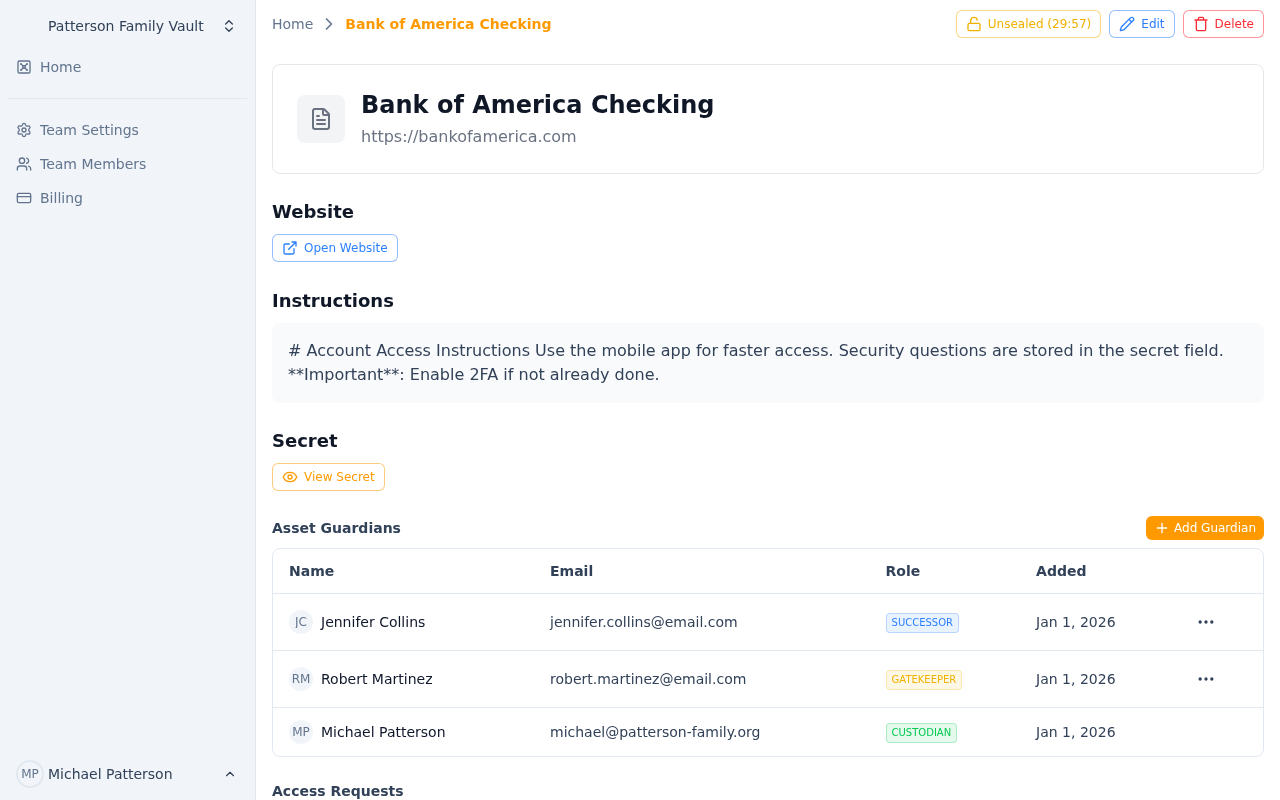 The three-tier guardian system: Custodian, Gatekeeper, and Successor
┌─────────────────────────────────────────┐
│           CUSTODIAN (Owner)             │
│  • Full control over asset              │
│  • Can access with identity unlocked  │
│  • Assigns all guardians                │
│  • Final approval authority             │
└─────────────────┬───────────────────────┘
                  │
         ┌────────┴────────┐
         │                 │
┌────────▼──────┐   ┌──────▼────────┐
│  GATEKEEPER   │   │   SUCCESSOR   │
│  (Overseer)   │   │ (Continuity)  │
├───────────────┤   ├───────────────┤
│ ✓ Approve     │   │ ✓ Request     │
│ ✓ Deny        │   │ ✓ Access      │
│ ✓ Monitor     │   │   (approved)  │
│ ✗ Access      │   │ ✗ Approve own │
│ ✗ Modify      │   │ ✗ Modify      │
└───────────────┘   └───────────────┘
Guardian Assignment Scenarios
Scenario 1: Startup Infrastructure Access
Asset: Production AWS Root Credentials
Guardians:
- Custodian: CTO (owner of credentials)
- Gatekeepers: CEO, Board Member (oversight without technical access)
- Successors: Senior DevOps Engineer, Backup CTO
Workflow: If CTO is unreachable, DevOps Engineer requests access. CEO must approve (gets alert). Access granted for 24 hours, fully logged, CTO notified.
Benefit: Production stays running even if CTO is unavailable, but CEO maintains business oversight and can deny suspicious requests.
Scenario 2: Estate Planning
Asset: Bank Account Credentials and Will
Guardians:
- Custodian: Parent (asset owner)
- Gatekeepers: Attorney, Trusted Friend (ensure proper access)
- Successors: Adult Children
Workflow: After parent's incapacitation, children request access. Attorney reviews request and approves after verifying circumstances. Children receive time-limited access to coordinate estate matters.
Benefit: Assets remain protected during parent's lifetime but accessible to heirs when needed, with professional oversight to prevent premature or inappropriate access.
Scenario 3: Client Account Management
Asset: High-Value Client Contract and Credentials
Guardians:
- Custodian: Account Manager (relationship owner)
- Gatekeepers: Sales Director, Compliance Officer (business + legal oversight)
- Successors: Backup Account Manager, Regional Manager
Workflow: Account Manager on medical leave. Backup requests access to continue client service. Sales Director approves after confirming business need. Compliance Officer receives notification. Access granted for duration of leave.
Benefit: Client service continues uninterrupted while maintaining proper oversight and documentation for audit purposes.
Scenario 4: Multi-Tier Approval for Critical Secrets
Asset: Domain Registrar Master Account
Guardians:
- Custodian: VP of Engineering
- Gatekeepers: CTO, CFO, Outside Board Member (three required approvals)
- Successors: Senior Engineer, IT Manager
Workflow: VP unreachable during DNS emergency. Senior Engineer requests access. All three gatekeepers must approve (prevents single-point compromise). After all approve, access granted.
Benefit: Extremely sensitive assets require consensus, preventing rogue access while ensuring emergency availability.
Flexible Guardian Management
Dynamic Assignment
Guardians can be added or removed at any time by the custodian:
- Promote team members to successor as they gain responsibility
- Add gatekeepers when oversight requirements change
- Remove guardians when employment ends or relationships change
- Adjust approval workflows as security needs evolve
Multiple Assets, Different Guardians
Each asset has independent guardian assignments:
- Development credentials: Junior team as successors
- Production credentials: Senior team only
- Financial accounts: Executive gatekeepers required
- Personal documents: Family as successors
This granularity ensures appropriate access without all-or-nothing permissions.
Guardian Removal Workflow
When a custodian removes a guardian:
- Immediate revocation of guardian role and permissions
- Email notification to removed guardian (transparency + audit trail)
- Automatic denial of pending access requests from removed guardian
- Audit log records removal reason and timestamp
- Optional replacement assignment in same action
Security Benefit: Quick response to employment termination or trust breakdown.
Benefits Over Traditional Access Control
vs. Shared Passwords
Problem: Everyone has the password = no accountability, no oversight, no security.
Key Man Out: Successors request access individually, actions logged, custodian always informed.
vs. Break-Glass Procedures
Problem: Physical safes, sealed envelopes, unclear who can access when.
Key Man Out: Digital, logged, time-limited, remotely accessible, approval-based.
vs. Full Admin Access
Problem: Giving someone admin access = giving them everything.
Key Man Out: Successors access only what they need, only after approval, only for limited time.
vs. Trust-Based Systems
Problem: "Just trust them not to access it unless needed."
Key Man Out: Gatekeepers provide verification without requiring blind trust.
Advanced Guardian Patterns
Separation of Duties
Assign different gatekeepers for different asset types:
- Financial assets: CFO + External Auditor
- Technical assets: CTO + Security Officer
- Legal assets: General Counsel + Outside Attorney
Geographic Distribution
Ensure business continuity across time zones:
- Primary Custodian: US East Coast
- Successor 1: US West Coast
- Successor 2: European Office
- Gatekeeper: Board Member (24-hour coverage)
Escalation Hierarchies
Structure successors by seniority:
- Tier 1 Successor: Direct report (can access with gatekeeper approval)
- Tier 2 Successor: Department head (requires two gatekeepers)
- Tier 3 Successor: Executive (requires all gatekeepers + time delay)
Bottom Line: The Guardian System gives you surgical control over who can access your secrets, under what conditions, with complete oversight and accountability—without creating new single points of failure.
Zero-Knowledge Encryption
Secrets and files are encrypted in your browser to personal age identities, with explicit guardian and escrow policies.
Intelligent Access Control
Match security to sensitivity with standard approval, time-delayed access, or DNS verification. Learn how Key Man Out provides flexible, intelligent access control workflows.